The Case for Neuro-Monitoring in Heavy Transport
Heavy vehicle operators function in high-risk, cognitively demanding environments where lapses in attention can have catastrophic consequences. Traditional recruitment and evaluation methods psychometric testing, behavioral interviews, and driving history fail to capture real-time neurocognitive states such as fatigue, vigilance decline, and workload saturation.
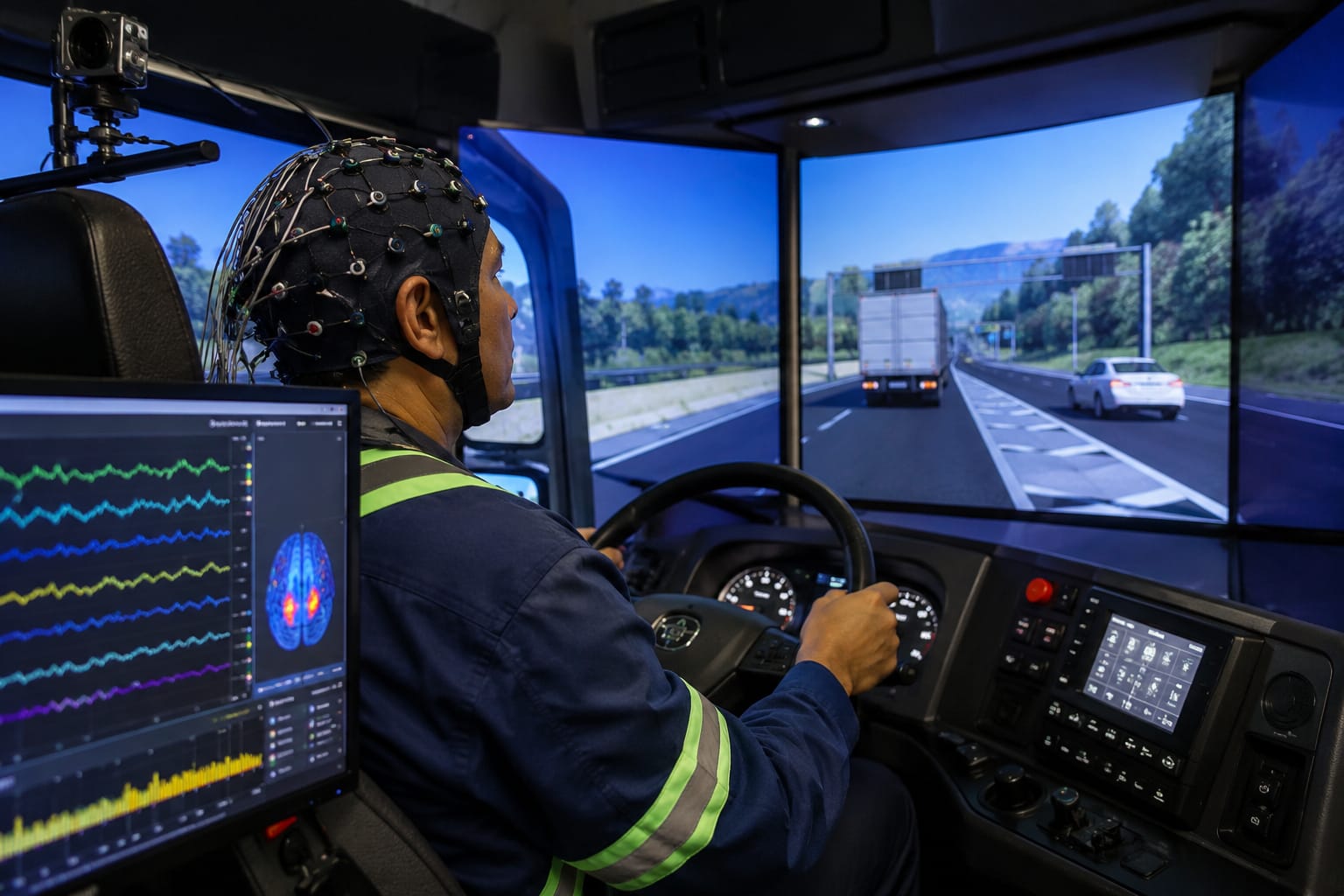
Electroencephalography (EEG) offers a direct window into cortical dynamics, enabling continuous monitoring of neural oscillations associated with attention, arousal, and decision-making. In simulator environments, EEG provides a controlled yet ecologically valid platform for assessing driver performance under varied stressors.
EEG Biomarkers of Driver State
Key EEG frequency bands have been consistently linked to driving performance:
Theta (4–7Hz): Elevated frontal theta correlates with mental fatigue and reduced vigilance (Lal & Craig, 2001).
Alpha (8–12Hz): Increased posterior alpha reflects decreased sensory processing and drowsiness (Jap et al., 2009).
Beta (13–30Hz): Associated with active cognitive engagement and motor control.
Advanced metrics such as theta/alpha ratio and event-related desynchronization (ERD) provide sensitive indicators of transitions from alertness to fatigue. These biomarkers can be mapped temporally against driving errors, lane deviations, and reaction times in simulators.
Simulator-Based EEG Integration
Driving simulators offer a reproducible environment where variables such as traffic density, weather, and time-on-task can be systematically manipulated. When combined with EEG:
- Neural responses can be aligned with specific driving events.
- Cognitive load can be quantified during complex maneuvers.
- Fatigue onset can be detected before behavioral errors emerge.
Modern systems integrate dry-electrode EEG caps with minimal motion artifacts, enabling near-realistic driving conditions without compromising signal quality (Debener et al., 2012).
Implications for Recruitment and Safety
From a recruitment perspective, EEG-enhanced simulation introduces a paradigm shift:
Objective Screening: Identify candidates with superior sustained attention and fatigue resistance.
Personalized Training: Tailor interventions based on individual neural profiles.
Predictive Risk Modeling: Combine EEG data with behavioral metrics to forecast on-road performance.
This aligns with emerging trends in neuroergonomics, where human-machine interaction is optimized using neural data (Parasuraman & Rizzo, 2008).
Ethical and Practical Considerations
Despite its promise, EEG deployment raises several concerns:
Data Privacy: Neural data is highly sensitive and requires strict governance.
Interpretability: Translating EEG signals into actionable insights demands robust models.
Scalability: Equipment cost and expertise may limit widespread adoption.
Balancing these factors is essential before integrating EEG into standard recruitment pipelines.
Closing Perspective
EEG monitoring in driving simulators bridges neuroscience and workforce safety, offering a powerful tool for understanding the hidden cognitive states that influence driver performance. As recruitment evolves toward data-driven precision, neurophysiological insights may become a cornerstone in selecting and training the next generation of heavy vehicle operators.